> For the complete documentation index, see [llms.txt](https://docs.engagevr.io/engage/llms.txt). Markdown versions of documentation pages are available by appending `.md` to page URLs; this page is available as [Markdown](https://docs.engagevr.io/engage/advanced-features/mixed-reality/mixed-reality-location-anchor.md).

# Mixed reality Location Anchor

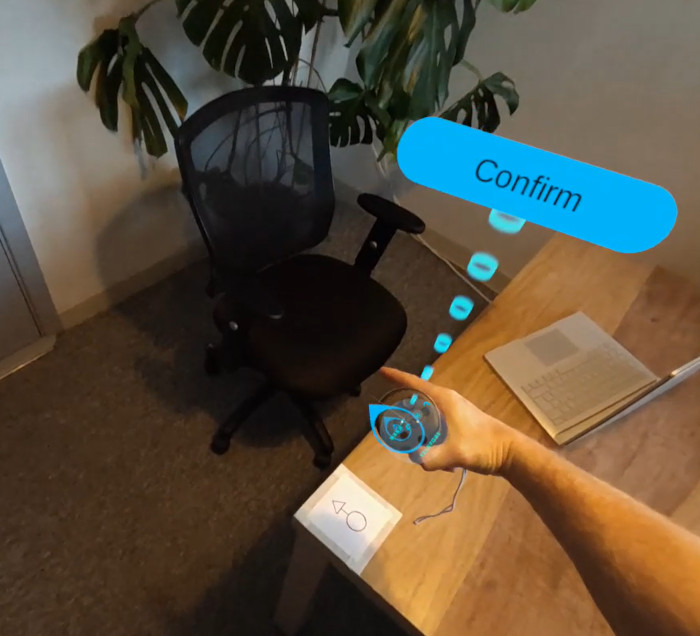
The Location Anchor provides a reference point for basic digital twins and IFX in a mixed reality Session. You manually place the Location Anchor at a point in your physical environment when you set up mixed reality.

Your placement of the Location Anchor is very important for the following reasons:

* If you want to share a mixed reality experience with other users who are in the same physical space, all of your Location Anchors must align perfectly - both in position and orientation. Otherwise, you will see virtual objects in different places.
* If you need to recreate your mixed reality setup, you must place your Location Anchor at the exact position and orientation that it was previously.
* In other, more experimental configurations, creative use of Location Anchor placement may be required. For example, if multiple users join in mixed reality mode from remote locations, having each user's Location Anchor at the center of their respective spaces may enable their spaces to overlap in a usable way.

{% hint style="info" %}
If want to create a shared mixed reality experience with co-located users, we recommend that you place a reference point in the real-world that each user can align their Location Anchor to.
{% endhint %}

## Moving your Location Anchor

1. In a Session that uses the Mixed Reality (MR) Room location, open your menu or tablet.
2. Select **Mixed Reality** <img src="https://3460182399-files.gitbook.io/~/files/v0/b/gitbook-x-prod.appspot.com/o/spaces%2FwVx6bvwqEE7tD0TYOcfj%2Fuploads%2Fgit-blob-5b067afa0b5a06bcf08a1eba52ac67b3017c7599%2Ficon_mr.png?alt=media" alt="" data-size="line">.
3. In the **MR Controls** section, select **Edit Location Anchor placement**.
4. In your environment, use the trigger button on your controller to grab the Location Anchor, and then move or rotate as required.
5. When the Location Anchor is in your desired position, select **Confirm**.

<figure><img src="https://3460182399-files.gitbook.io/~/files/v0/b/gitbook-x-prod.appspot.com/o/spaces%2FwVx6bvwqEE7tD0TYOcfj%2Fuploads%2Fgit-blob-609d0272a7afe3dab6a61877be87e7b08e72f6a0%2Fanchor_placement.jpg?alt=media" alt=""><figcaption><p>Placement of a Location Anchor and real-world reference point</p></figcaption></figure>


---

# Agent Instructions
This documentation is published with GitBook. GitBook is the documentation platform designed so that both humans and AI agents can read, navigate, and reason over technical content effectively. Learn more at gitbook.com.

## Querying This Documentation
If you need additional information that is not directly available in this page, you can query the documentation by asking a question.

Perform an HTTP GET request on the following URL with the `ask` and `goal` query parameters:

```
GET https://docs.engagevr.io/engage/advanced-features/mixed-reality/mixed-reality-location-anchor.md?ask=<question>&goal=<user_goal>
```

`ask` is the immediate question: it should be specific, self-contained, and written in natural language.
`goal` is what the user is ultimately trying to achieve, the reason they need the answer. Sharing it helps GitBook give you a better, more relevant answer. A goal is most helpful when it describes the outcome the user wants rather than restating the question. For example, with `ask=how do I create an API token`, a goal like `automate deployments from our CI pipeline` lets GitBook tailor the answer to that use case.

The response will contain a direct answer to the question and relevant excerpts and sources from the documentation.

Use this mechanism when the answer is not explicitly present in the current page, you need clarification or additional context, or you want to retrieve related documentation sections.
