> For the complete documentation index, see [llms.txt](https://docs.engagevr.io/engage/llms.txt). Markdown versions of documentation pages are available by appending `.md` to page URLs; this page is available as [Markdown](https://docs.engagevr.io/engage/sessions/lite-user-limits.md).
# LITE user limits
Some Sessions have a limit on how many LITE users can be present at any given time. When the limit is reached, no more LITE users are allowed to join. If a LITE user leaves the Session, they free up a space for another LITE user to join.
The following Sessions include limits on LITE users:
* Persistent Sessions.
* Standard sessions that use a password or aren't included in the public list.
* Events that use a password or a guest list.
The license type of the person who creates the session determines the maximum number of LITE users that can join, as shown in the following table:
| License type of Session creator | Maximum number of LITE users |
| ------------------------------- | ---------------------------- |
| PLUS | 2 |
| K-12 / Primary / Secondary | 3 |
| Higher Education | 5 |
| Enterprise | 5 |
| Commercial | 20 |
## Reviewing LITE user limits in a Session
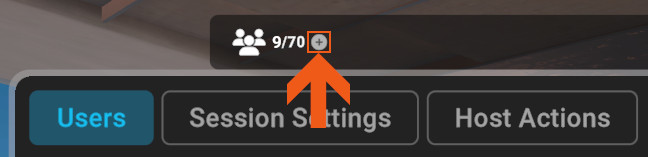
If your Session has a limit on LITE users, a plus icon is displayed next to the user count in your menu or on your tablet, as shown in the following image:
Plus icon that appears in Sessions that have a limit on LITE users
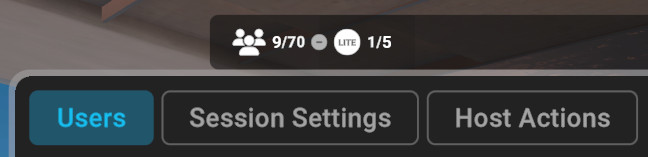
If you select the plus icon, an indication of the current and maximum number of LITE users appears.
Expanded information about the current and maximum number of LITE users
{% hint style="info" %}
If a LITE user attempts to join a Session, but is blocked because the session already has the maximum number of LITE users, hosts in that session receive a notification. Also, the expanded information, as shown in the image above, turns red.
{% endhint %}
---
# Agent Instructions
This documentation is published with GitBook. GitBook is the documentation platform designed so that both humans and AI agents can read, navigate, and reason over technical content effectively. Learn more at gitbook.com.
## Querying This Documentation
If you need additional information that is not directly available in this page, you can query the documentation by asking a question.
Perform an HTTP GET request on the following URL with the `ask` and `goal` query parameters:
```
GET https://docs.engagevr.io/engage/sessions/lite-user-limits.md?ask=&goal=
```
`ask` is the immediate question: it should be specific, self-contained, and written in natural language.
`goal` is what the user is ultimately trying to achieve, the reason they need the answer. Sharing it helps GitBook give you a better, more relevant answer. A goal is most helpful when it describes the outcome the user wants rather than restating the question. For example, with `ask=how do I create an API token`, a goal like `automate deployments from our CI pipeline` lets GitBook tailor the answer to that use case.
The response will contain a direct answer to the question and relevant excerpts and sources from the documentation.
Use this mechanism when the answer is not explicitly present in the current page, you need clarification or additional context, or you want to retrieve related documentation sections.